TRANSITION TO A SUNDOWN TOWN
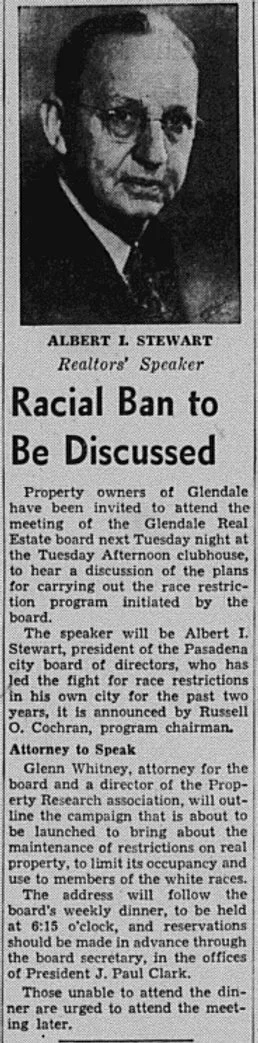
While Tropico may have been more accepting of having a racially diverse community, just a few blocks up north, the city of Glendale proper, was strategically establishing itself to be the opposite.
In the spring of 1907, Dr. H. C. Garrott, a scientist who had recently moved to Glendale with his family, returned home to find an anonymous letter addressed to him, with the line, “To the only colored man in Glendale” [11].
The letter read, “ Dear Sir: You and your family must leave here at once. You are a negro and are not wanted here. Leave here by April 1st or April 10th or suffer the consequences thereby. You MUST! [Signed] ‘COMMITTEE’” [11].
Dr. Garrott noted that buying a house in Glendale had been very difficult as “it seemed that no one would see a colored person”, reported The Los Angeles Times [11].
Dr. Garrott’s discriminatory experience was unfortunately very common in Glendale during this time.
While there were never any official explicit racial laws passed in Glendale, residents and officials were able to segregate the town through less explicit forms. This led to the formation of Glendale as a “sundown town”.
A “sundown town” is a term for a town or city through which official or unofficial methods only allow white residents. The phrase comes from the idea that if you were a person of color, you had to be out of the town by sundown, or else face consequences which often included harassment and violence [12].
Private institutions in Glendale, such as Forest Lawn Cemetery, made no secret of their racially discriminatory practices. In 1922, Forest Lawn even suspended the scheduled funeral for a woman, Hattie de Jarnette, the day before she was scheduled to be buried, despite the arrangements being set by her family and the cemetery [13]. The reason they cited was that “the rules of Forest Lawn Memorial Park prohibit the burial of any person not a member of the Caucasian race” [13]. When Forest Lawn discovered that Jarnette was African American, they took her family to court on account of fraud [13]. Forest Lawn officials additionally cited that they would use Jarnette’s case as further evidence for why they would not allow burials of non-white people [13].
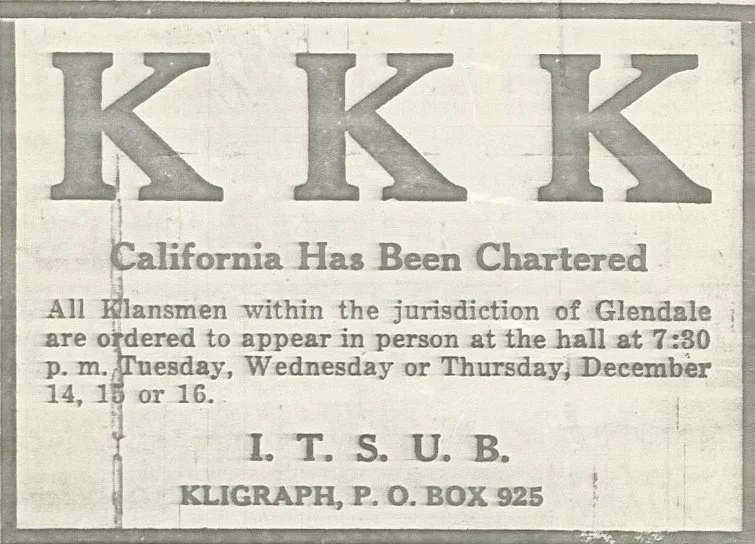
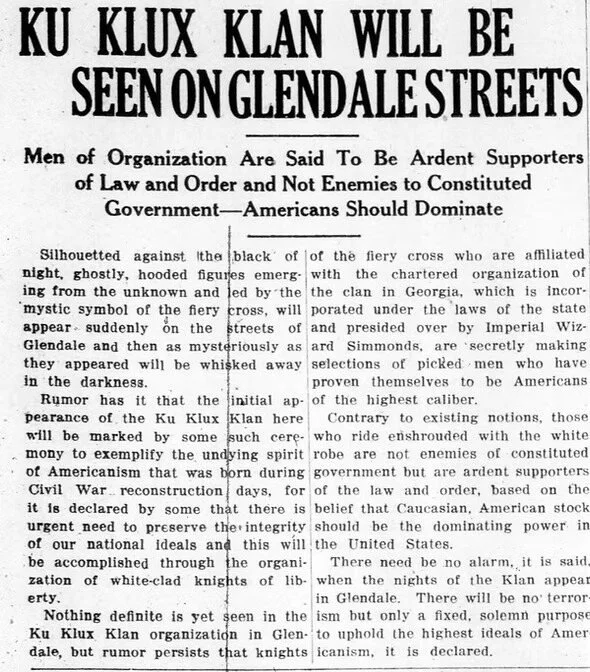
Racial tensions further increased in Glendale as the Ku Klux Klan established a presence there during the late 1920s and 30s, and it was not uncommon to see them throughout the city [14]. The Los Angeles Times reported that in 1939, “12 white-robed but unhooded men invaded the downtown shopping district the second time in less than a week and distributed K.K.K. handbills without police interference” [15]. The Glendale Police determined that this activity was lawful and constituted free speech rights.
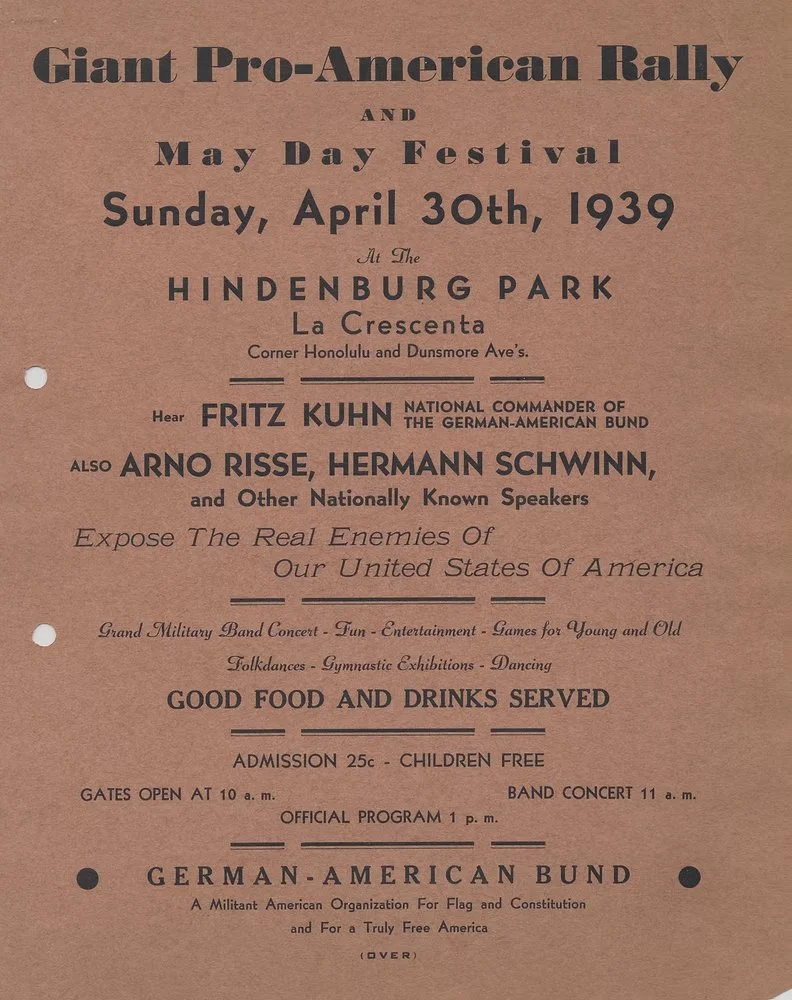
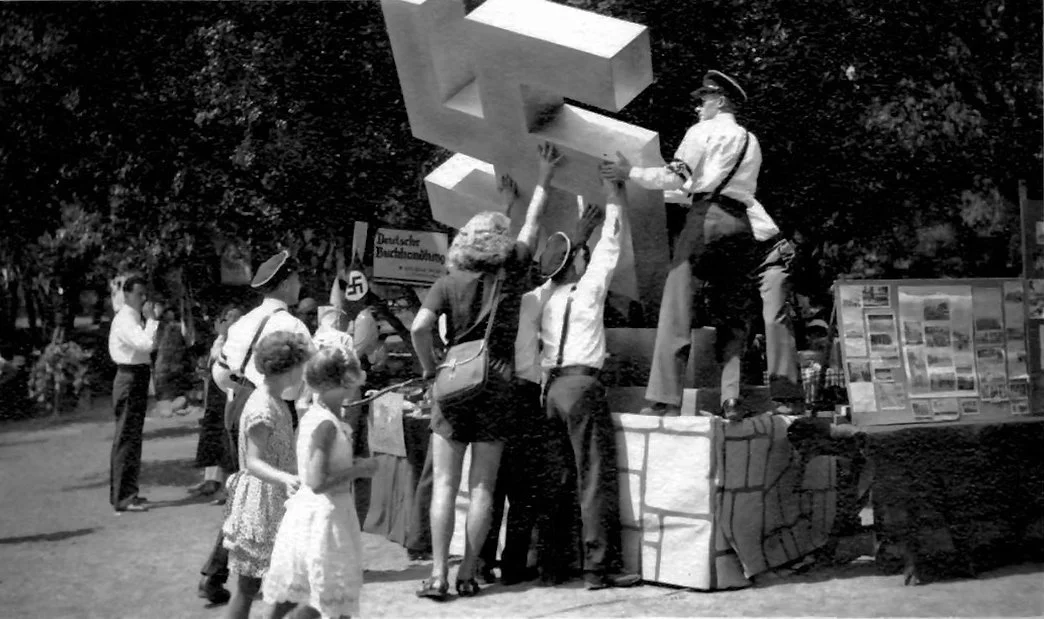
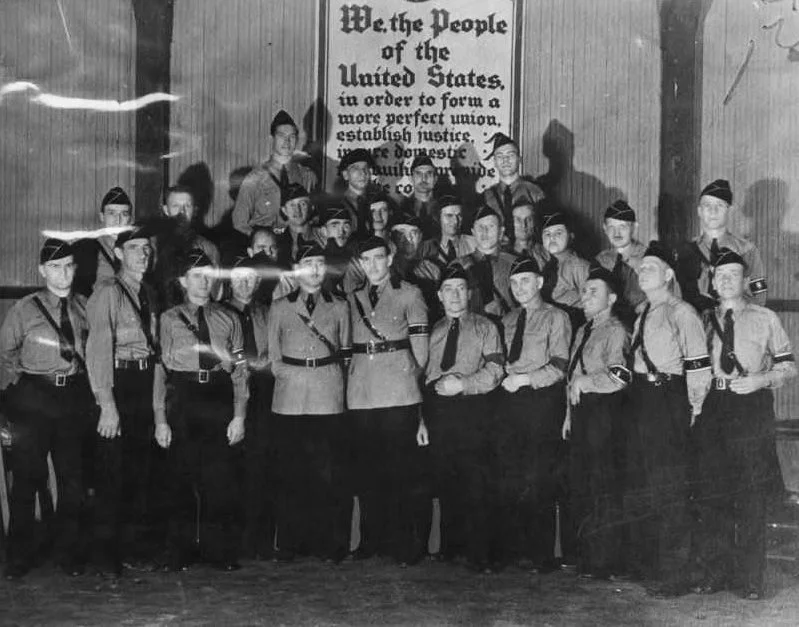
Additionally, during the 1930s, the La Crescenta neighborhood of Glendale was home to a division of the German American Bund, a pro-Nazi organization which frequently hosted “German Days” in Hindenburg Park (now Crescenta Valley Community Regional Park), which were merely a guise for spreading propaganda [22].
While the earliest examples of sundown town practices in Glendale were specifically directed at African Americans, their target shifted to Japanese Americans during World War II, during which their efforts became much more explicit.
Click on image to learn more.
Click on image to learn more.
Click on image to learn more.
Click on image to learn more.
Click on image to learn more.
Click on image to learn more.