REFLECTION
About this Project
The idea for this project came from wanting to understand how course themes—such as exclusion and orientalism–unfolded in my own community.
I grew up in Glendale and by going on tours with the Glendale Historical Society, and searching through archival magazines, newspapers and photos over the years, I realized that while there is a lot of documentation on Glendale’s history, and its past as a sundown town, I have never seen it considered in the context of Asian American history, which it has many connections to.
While it’s easy to find information on Tropico’s original Japanese settlement, Glendale’s incarnation as a sundown town, or even the prominence of Japanese-themed parties, they are not typically analyzed in the context of one another.
This website aims to consider these key chronological periods in Glendale’s history and how they might have led into one another.
Additional Course Connections to the Website’s Sections:
Early Japanese Presence:
Learning about the early Japanese community in Tropico and Glendale reminded me of The Four Immigrants Manga by Henry Yoshitaka Kimaya. Although Glendale had exclusive sentiments from its establishment, they “accepted” the Japanese community when they found them “useful” and “rejected” them when they were no longer of service. In Glendale, Japanese farmers were able to lease land in the city, but once the strawberry crops were no longer prosperous, the Japanese community was no longer welcome. This theme demonstrated in The Four Immigrants Manga, how the four immigrants are praised and patronized for their service, but the minute they fail to live up to their employer’s expectations, they are kicked out and belittled. Historically, this is also repeated through the creation of the American railroads and how Chinese workers were highly sought out to work on them. The minute they were completed however, these workers were brushed aside, and not even allowed to ride the trains back for free.
Transition Into a Sundown Town:
A course theme this connects to is the idea of “Exclusion before Federal Law”. While there was no specific law that explicitly stated that people of color could not live in Glendale, from contemporary reevaluation, it is without question that Glendale operated as a sundown town. Minority groups were excluded from the city through private matters (such as Forest Lawn prohibiting non-white burials), which eventually shifted to the more explicit efforts by the Race Restrictions Committee, which even attempted to pass real laws (such as Proposition 14).
This reminds me of the way that Chinese exclusion was strategically and slowly enacted. “Smaller” laws such as the “Page Act” focused on regulations that did not explicitly state race, despite it being their true target. After many similar “small” acts like these were passed (for instance the laws that required specific coding and regulations for laundries as an effort to exclude Chinese), it finally led up to the very explicit Chinese Exclusion Act, with very blatant racial language.
A Note On This Project…
This project was created by Sonja Krause as the final project for Dr. Courtney Sato’s “Introduction to Asian American Studies” course at Tufts University in Spring 2026. While this project focuses on the history of the city of Glendale, California, the creation of the project is not affiliated with the city itself.
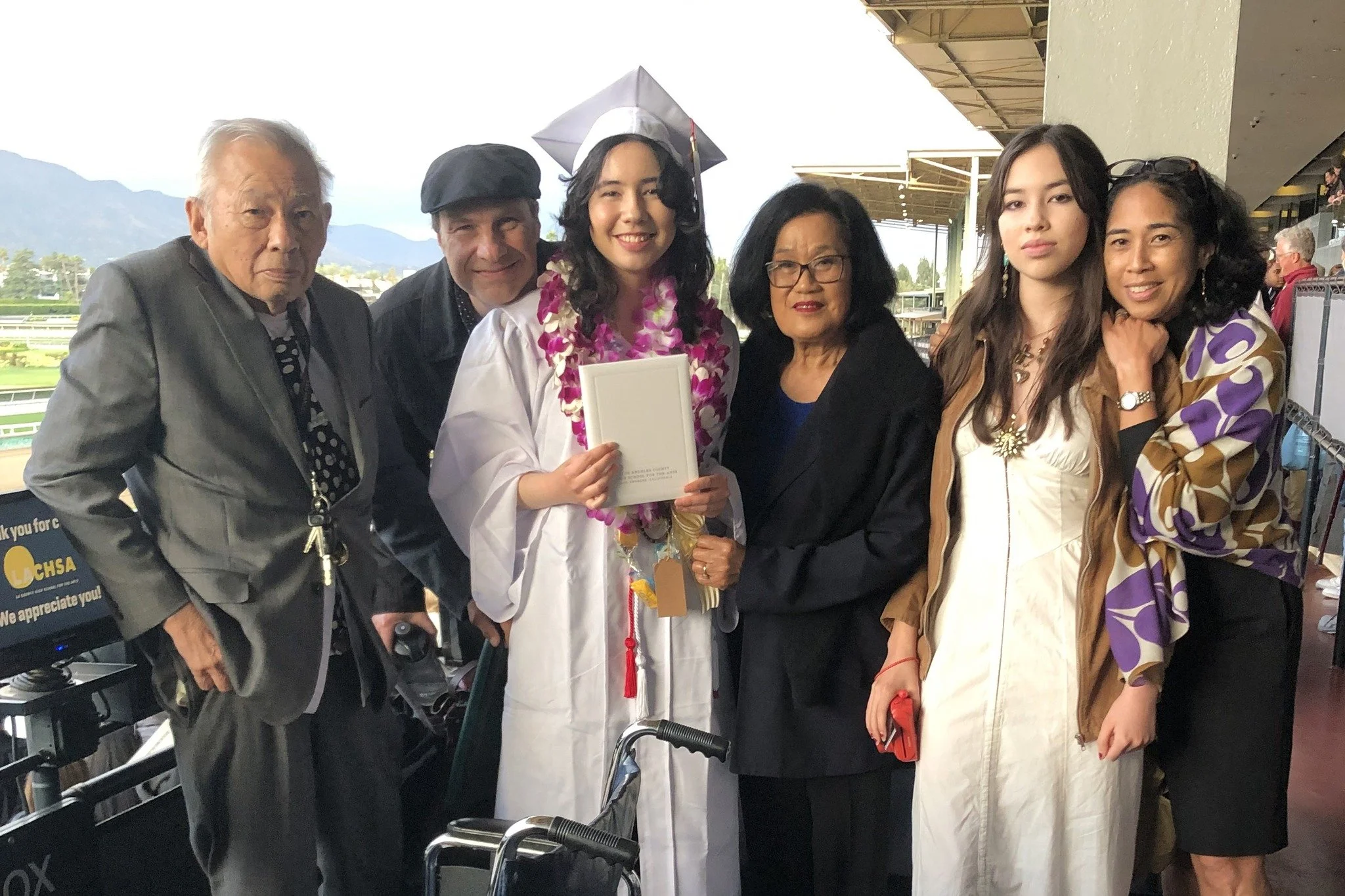
A photo of the author, Sonja Krause, and her family who raised her in Glendale.
Many thanks to:
Taleen Barsoumian – President of the Glendale Historical Society
Katherine Peters Yamada – Director of the Glendale Historical Society
Beverly Gobiel – Library Coordinator, Special Collections Tisch Library at Tufts University
Dr. Courtney Sato